June 18, 2013

Boating on Historic Lake of Gennesaret (or Sea of Galilee)

Afternoon of Tuesday, June 4, 2013

I was sad to leave Nazareth Village, but we had an appointment with a boat. We retraced our route back down to the Sea of Galilee, stopping at a local restaurant for lunch. About 10 picnic tables under an arbor provided outdoor seating, which on this beautiful day was perfect! I think I’ve mentioned that one of the national dishes—and one all tourists must try—is falafel, a deep-fried ball or patty made from ground chickpeas, fava beans, or both. It is usually served stuffed into a pita and topped with vegetables, humus, sauces, and even French fries! Americans have hamburgers; the Middle East falafel! 

After lunch we drove to someplace beside the Sea and boarded our boat for a ride on the Sea Galilee. These special tourist boats ply the Sea and give visitors a firsthand experience on this most historic freshwater lake. So many miracles were performed near and on this body water!


Our boat was named "Faith."


After boarding and pulling away from the dock, the boatmen play the national anthem of whatever group is on board and raise their flag. The stirring strains of “The Star Spangled Banner” brought tears to our eyes.


Hills around the Sea of Galilee; Ruins of Capernaum on the Shore
Not many, but several sailboats were on the sea near the museum.

We couldn’t have asked for a better day to make this journey on the Sea. About a half hour later, we disembarked at the dock of the Yigal Allon Museum on the grounds of Kibbutz Ginosar. The museum houses the “Jesus boat,” the authentic remains of a first-century boat discovered in the mud on the northeastern shore of the Sea of Galilee in 1986. The intriguing story of its discovery, removal from the mud, and preservation can be seen on the "Jesus Boat" webpage under the tab Galilee Boat. It includes two videos besides the printed word.

Front of the Museum
Preserved first-century boat typical of the those used at the time of Jesus.

Besides the display of the boat, the modern museum houses a small snack shop and gift store where, even after all our days in Israel, we still found items to purchase.
We didn’t return on the boat because our bus driver met us at the museum. With some extra time in our itinerary, Yossi took us to what has become a large tourist attraction in Tiberias called the Galilee Experience. It was founded in 1990. A young Messianic Jew explained the Messianic movement in Israel today and left us to view their "world class multimedia presentation" that "will inspire, inform and entertain you with what God has done in this incredible Land."


An ancient Torah scroll is displayed in the theater.


I recommend reading the history of the Galilee Experience found on their webpages under the About tab.

When tourism diminished significantly in 2000, the founders of the Galilee Experience looked for other ways to earn income which resulted in them becoming "one of the largest Jewish roots product distributors to the Christian communities around the world." They sell these products online. Who knows, you may want to purchase some Holy Land items. You can also sign up to receive their newsletter.

Tomorrow we must be packed and have suitcases outside our door by 7 am. It will be our last day in this key country in God’s plan of the “latter days.” I tried to find a word to describe its attraction and appeal, but I couldn’t come up with one. The English language simply doesn’t have a word to convey its mystique and why it attracts millions of tourists each year—or perhaps it’s my lack of knowing English well-enough to find that word. The thesaurus didn’t help!

June 17, 2013

"He shall be called a Nazarene"

Morning of Tuesday, June 4, 2013

Today was beautiful. During the night a wind blew away the high temperatures and the haze that perpetually hovers over the Sea of Galilee. It was cool and clear when we boarded the bus to head over the hills to Nazareth. We began our ascent from 686 feet below sea level, winding our way through the countryside catching glimpses of spectacular views of the Sea and surrounding country.


Close to Nazareth we drove through Cana, the village where Jesus performed the first recorded miracle—changing water into wine at a wedding. Predominantly Arab, Nazareth today has a population around 65,500. At the time of Jesus, two thousand years ago, some sources estimate the population at 200 to 400 people; others 500 to 1000.  
 
Shop in Nazareth selling very large "tortilla"-like bread. The black dome in the forefront is the "griddle."
Tourist shop on street in Nazareth

Our first stop, the Church of the Annunciation commemorates the traditional site of Mary’s home where the archangel Gabriel proclaimed to a humble young girl the startling news that the Lord had found favor with her and selected her to bear a son who would be the Son of God. Inside the church and surrounding courtyard walls hang charming artwork donated from countries around the world that depict Mary and the Christ child. 

Front of the Church of the Annunciation


Our group was the first to arrive and this allowed us quiet time to explore the church. The present Catholic Church was built on the site of two prior churches constructed over the “sunken grotto,” the traditional cave-home of Mary. Sometimes services are held in the lower portion and visitors cannot get near the “home” but none were being held today so we were able to get close to the grotto.
 
Worship service in lower church (2009)
Sunken grotto with cave-home of Mary inside the church.

Close to the Church of the Annunciation is St. Joseph’s Church which tradition says was the place of Joseph’s carpenter shop.

The sculpture on St.Joseph's Church is "one of my husband's favorite things" in Israel.

Inside St. Joseph's. Note the wooden ceiling.


Finally we arrived at "one of my favorite" places in Israel: Nazareth Village. I could write several blog entries on this because I find it so meaningful. This re-created first-century farm and village, constructed on a hillside in the heart of Nazareth, became a reality in 2000. The purpose of the village is to transport visitors back to the time of Christ to help them gain a deeper appreciation and understanding of the Scriptures and Jesus’ teachings—to make Biblical accounts come alive. And that’s exactly what happened when we came in 2009 and again this time.

Archaeological excavations before the re-creation of the village revealed an exciting find: an original wine press and vat. It confirmed that this hillside now surrounded by modern Nazareth was a vineyard many years ago. They restored it and built terraces on the hill where they re-planted the “vineyard” with grape plants and olive trees. 

Grapes were crushed at the place at top, and the juice would come down the small crevice (center top) to receptacle.


Re-enactors at the village include a shepherd (plus sheep and goats!); workmen in the fields; watchman in the watchtower; a carpenter and woman of the home; others; and donkeys to enhance the teaching of the village. 


The village also grows wheat and threshes it on a replica of an ancient threshing floor. There is an olive press; typical home at the time of Jesus; and a simple synagogue. 

Daniel, our village guide, explains the function of a synagogue.

A few changes had been made since 2009. A cross had been added in the visitors’ center of four rooms with informational displays designed to enrich understanding of the history of the village and the life and times of Jesus. This cross and the explanation by Daniel, our village guide, meant much more to me than the original Golgotha at the Church of the Holy Sepulcher. This was reality—stark, rough wooden cross stained with blood. While Jesus was crucified by the Roman soldiers, He gave his life—they didn’t take it. He died within six hours of being nailed to the cross—many required three days before they died.


For those who cannot go to Israel, I highly recommend exploring the Nazareth Village website.


June 14, 2013

Lovely Afternoon around the Sea of Galilee

Afternoon of Monday, June 3

We ate at an elegant restaurant on the southeastern side of the sea that is part of a cultural and social center called Bet Gabriel. In 1994 King Hussein and Prime Minister Yitzhak Rabin signed the peace accord at this lovely place. Art galleries, aquariums in the restaurant, and outside dining overlooking carmine red bougainvillea growing beside the sea add to the ambience. 

Group at lunch, Bet Gabriel
One of several aquariums at the restaurant.


View of the Sea of Galilee from the restaurant.

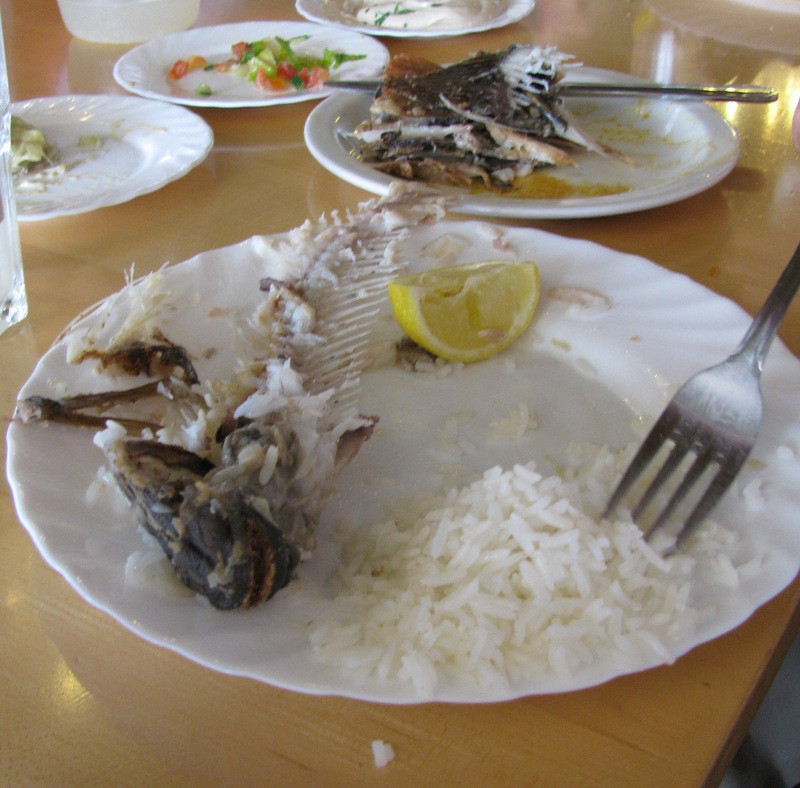
The set meal included the standard first course, items of humus and different vegetables with pita bread. Beef could be ordered instead of St. Peter’s fish, which some of our group chose to do, and the fish could come with the head or without! Since we had eaten fish fixed a variety of ways in China, Lyle and I chose “with the head.” A large side of yummy rice accompanied it. Someone asked me to take a photo of the fish before it was eaten, but I used her camera and find I don’t have one as it was served, but found an image on Wikipedia. St. Peter’s fish is tilapia. 

 
I do have, however, one from my husband’s after eating. It looked like a cartoon cat had swallowed the flesh off and pulled the remaining bones out of its mouth!


Near the restaurant is a baptismal site called Yardenit where, if you so choose, you can be baptized in the Jordan River. This is not where Jesus was baptized, but a place to remember the event. By now we had come almost full circle around the Sea of Galilee as Yardenit is located where the Sea empties into the Jordan River at its southern end. A stone throw’s away south of Yardenit is Degania Alef, the first kibbutz (a communal settlement) in Israel, established in 1910.


Pilgrims entering water for baptism.

Yossi added some bonus places today not on the original itinerary. These included the Kinneret Farm that processes dates and spices, the Kinneret Kibbutz cemetery, and Caprice, the headquarters in Tiberias for polishing diamonds. The farm, only five minutes from the baptismal site, sells locally made products and allows customers to sample different kinds of dates that grow throughout Israel. It also sells mixes for teas or infusions, spices to add to rice and other dishes, date honey, and many other items. I purchased some hyssop that was used in preparing the chicken we ate when we enjoyed “Abraham's” hospitality. The Farm has a webpage, translated into English, where you can order products online. 


I got the Marakesh rice seasonings along with some hyssop.

A short distance from the farm is Kinneret Kibbutz Cemetery which borders directly on the Sea of Galilee. We had been here in 2009, and its lovely setting and stories of famous Israelis touched our hearts. I snapped some of my favorite photos from Israel at this cemetery, where Israeli students come on field trips. The photo below is of an older Israeli student singing for the younger children (just below this one) on one of those field trips, and I think this is my very favorite photo from our 2009 tour. 


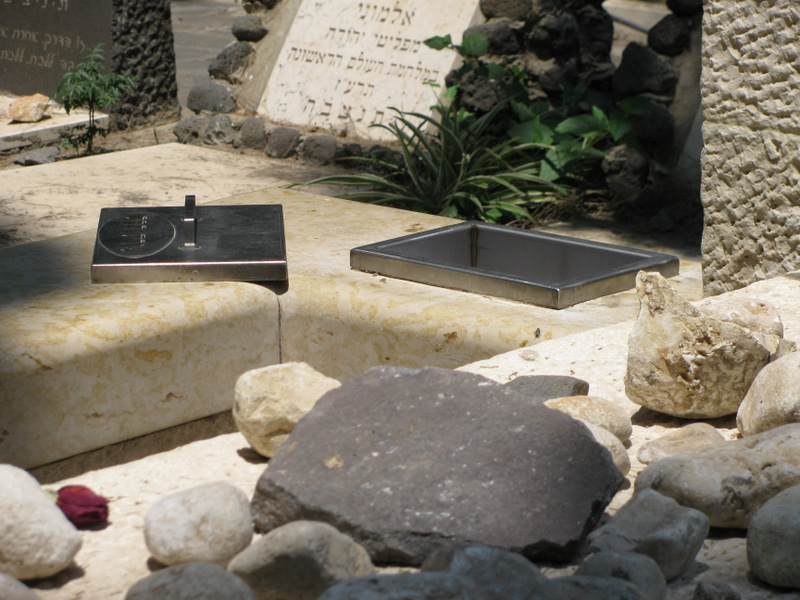
The grave that captured our attention both in 2009 and this time is that of Rachel Bluwstein, a Hebrew poet known only by her first name and who immigrated to Israel in 1909. The photo of her grave in 2009 shows the Israeli custom of placing stones, instead of flowers, on the grave marker. 


Beside the grave of Rachel is a bench for visitors, and linking the bench to the grave is a metal box inserted in the stone where copies of her poems are available for visitors to read. Yossi had brought translations into English of some of her poems that we read while contemplating the beauty around us and the beauty of her words. You can read four of her poems translated into English on the Palestine-Israel Journal website.


Yossi and Diane Peterson read Rachel's poems.

Another favorite photo, taken on this tour here at the cemetery, is this view of the Sea of Galilee.


A few minutes from the cemetery brought us full circle around the Sea as we returned to Tiberias. Since we had some “extra” time, Yossi took us to Caprice, a diamond processing factory and showroom at Tiberias. Did you know that Israel cuts, polishes, and sets over 65 percent of the world’s diamonds? Special technology allows them to cut diamonds with 58 facets, more than anyone else. The World Wide Web still amazes me. Almost every place we visited has a webpage! You can read more about the Caprice diamond showroom online. 
 
We made it back to our hotel in good time to rest a bit before another fantastic evening meal and fellowship with our fellow travelers. Our tours wouldn’t be the same without the great people who go with us and the uplifting sharing we do as we break bread together. 

Tomorrow was my favorite day. Join me as we visit Nazareth and climb aboard a boat for a short ride on the Sea of Galilee.